
Blog
Just Ask the Principal
Welcome to “Navigating Leadership Excellence” Blog
Your go-to resource for aspiring and current school leaders ready to elevate their leadership skills, foster positive school cultures, and make lasting impacts in education. Whether you're an assistant principal, an aspiring school leader, or a new principal navigating the complexities of your role, this blog is designed to guide you every step of the way.
Drawing from years of experience in coaching, mentoring, and leadership development, I share practical strategies, real-life examples, and actionable insights to help you grow as a leader. From managing teams to implementing academic interventions, my goal is to provide you with the tools, resources, and inspiration needed to confidently lead your school to success.
Explore the blog and discover how to unlock your full leadership potential!
The Silence Is Why Most People Don't Get Well
One of my absolute favorite movies is The Bridges of Madison County.
If you know the story, you know it begins with a discovery. The main character's children find a collection of letters and journals she left behind after her passing. These letters document a profound, hidden chapter of her life—her connection with Clint Eastwood's character.
When her children first start reading them, they are uncomfortable. The son thinks it is too much. But the daughter has a completely different reaction. She reads her mother's words and says, "Oh my god, this is so Mom. I feel like I know her even more now."
Her mother had kept those letters. She documented what she lived, what she felt, and what she understood. And by leaving them behind, she gave her children the gift of her full truth.
This is exactly why I document what I have been through. It is why I write about what I see, what I understand, and how I live now.
Because the silence is why most people suffer. Some people don't get out of it, and some don't get well, simply because no one is talking about the reality of the experience.
In leadership, the silence is deafening.
We talk about strategies, frameworks, and key performance indicators. We talk about school improvement plans and pipeline development. But we rarely talk about the personal cost. We don't talk about the isolation. We don't talk about the moments when the picture shatters, or the exhaustion of always having to be the one holding the wall up.
Leaders suffer in silence because they believe they are the only ones struggling. They think if they admit how heavy the work actually is, it means they are unfit for the position.
But the opposite is true.
When we break the silence, we give others permission to heal. When we document our actual experiences—the failures, the fatigue, the weeping before the building—we leave a map for the leaders coming up behind us.
I don't want to leave behind a legacy of perfect, polished leadership theories. I want to leave behind letters. I want the leaders I mentor, the schools I support, and the people who read my work to say, "I feel like I know what it actually takes to lead now."
If you are suffering in silence in your leadership role, I want you to know you are not alone. You do not have to carry it by yourself. And you do not have to pretend the wall isn't heavy.
Breaking the silence of leadership is why I built The Nehemiah Principle. If you are looking for a space to do the real, internal work of leading, click here to join us.

Why Nehemiah Wept Before He Built
I always wanted to become a school principal. I don’t think I really knew what the cost would be. And I wouldn’t have changed a thing.
All I ever wanted to do was become a principal.
I knew I wanted to be a teacher from the beginning. I side-barred into communications during my freshman year of college, but I came right back to what I always wanted to do. And I also knew I wanted to reach the highest level of that profession. People would say, "You'll never make enough money as a teacher," so I set my sights on the principalship.
I was incredibly intentional about my path to becoming a principal. I checked the boxes. I put my head down. I never had a doubt that it would happen.
But what I did not understand was the gap between what I wanted, what I thought it would look like, and what the path to actually live inside that dream would require.
When you finally get into the position you want, the reality of it is rarely the picture you painted in your head. The title is the same, but the weight is entirely different.
This is the exact gap I found when I began closely reading the biblical story of Nehemiah.
Nehemiah had a clear vision. He was intentional. He secured the resources, he got the king's blessing, and he made the journey to Jerusalem to rebuild the broken wall. He had the plan perfectly mapped out in his mind.
But when he finally arrived and looked at the reality of the ruins—when he saw the actual devastation with his own eyes—he wept.
He didn't weep because he was giving up. He didn't weep because he lacked the skills to do the job. He wept because he finally allowed himself to feel the full weight of the distance between what he had envisioned and what was actually in front of him.
That weeping moment is not weakness. It is the most important leadership lesson nobody teaches.
We tell leaders to cast a vision. We tell them to be resilient. We tell them to execute the plan. But we rarely give them permission to grieve the gap between the dream they pursued and the reality they inherited.
If you are a leader who has reached the top of your ladder, only to look around and feel overwhelmed by the ruins you are expected to rebuild, you are not alone. You are not failing. You are simply standing where Nehemiah stood.
Before you can build, you have to be honest about what is broken. And sometimes, the most productive thing a leader can do is allow themselves to feel the weight of it.
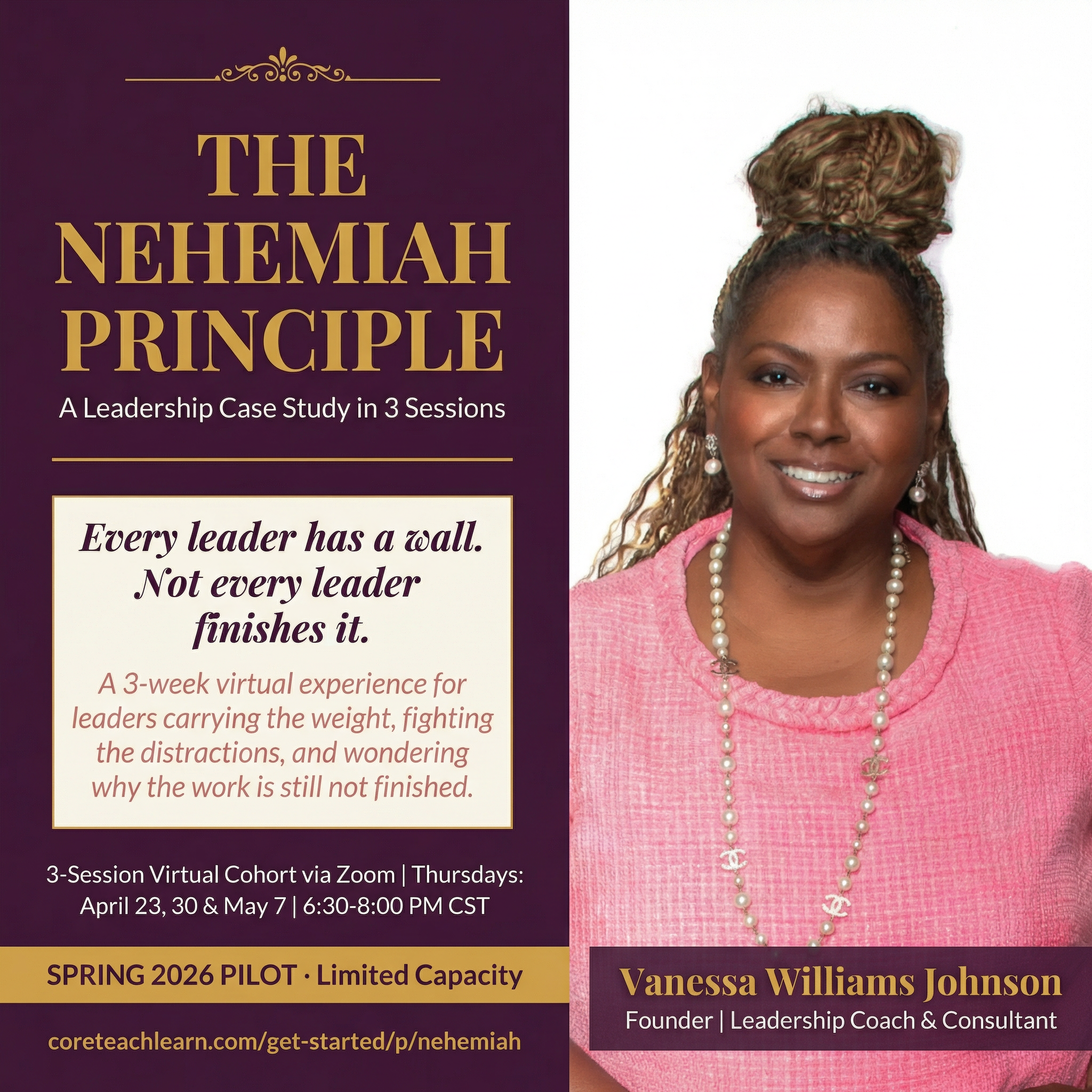
Understanding this gap is the first step of The Nehemiah Principle. If you are a leader navigating the space between the dream and the reality, click here to learn more about our upcoming intensive.
The Evolution of a Leader: From the Pipeline to the Wall
When I first launched this consultancy, my focus was clear: I wanted to mentor and prepare aspiring principals. After nearly 20 years leading a school and over three decades in education, I knew exactly what the principal pipeline was lacking. I had the strategies, I had the experience, and I wanted to help the next generation of school leaders step into their roles with confidence.
But as any experienced leader will tell you, the path you set out on is rarely the path you stay on.
As I began working with districts, my scope expanded. I moved from one-on-one mentoring to building comprehensive frameworks for district-wide leadership. That work eventually led me to my current role as a school improvement specialist, where I have spent the last several months working directly with 14 different schools. My focus shifted from preparing individuals for the seat, to helping entire school communities improve their systems, their culture, and their outcomes.
I love this work. It is deeply necessary. But alongside the data, the KPIs, and the strategic frameworks, something else was happening.
In my "reset"—my new life after retirement—I finally had the time to decompress. And in that quiet space, the lessons of my own 34-year career began to crystallize in ways they never could while I was in the thick of it. When you are in the seat, you are just moving. You roll over challenges, put them in the rearview mirror, and keep going. You don't have time to stop and inspect the damage. As long as the wheels haven't fallen off, you forge ahead.
I realized that while we are busy building pipelines and improving schools, the leaders actually doing the work are burning out. There is a part of leadership that nobody has a class on. There is no set way to handle the internal fractures, the sheer exhaustion, or the weight of carrying a vision when the reality of the job doesn't match what you dreamed it would be.
At the beginning of this year, I was challenged to look back at where I had been and bridge it to where I was going. During that reflection, I was drawn back to the biblical story of Nehemiah.
As an ELA teacher by nature, close reading is my strategy. I approached Nehemiah the way I would a Socratic seminar—with deep inquiry. I took it a chapter a day. I read the commentary. I asked every question. I wanted to understand exactly what his thought processes and motives were. Here was a leader who willingly walked into a broken situation, surveyed the ruins, faced intense opposition, and refused to quit.
I took every step of that ancient text and connected it to my modern business framework and my lived experience as a principal.
That is how The Nehemiah Principle was born.
This is not just another leadership training. It is a deeply personal leadership case study designed for those who are tired, burnt out, or carrying the heavy weight of the work. It is for the leader who needs to reorient themselves to the actual process of leadership—the part that happens inside.
My work with aspiring leaders and school improvement continues. But The Nehemiah Principle is the work that speaks to me personally. It is the bridge between the professional frameworks we use to run our schools and the internal resilience we need to survive them.
If you are a leader navigating a challenging season, or if you simply need to reset your vision before you burn out, I invite you to join me for this pilot program.
We will spend three weeks looking at how Nehemiah assessed the damage, built his team, handled his critics, and finished the wall. And more importantly, we will look at how you can do the same.
The Nehemiah Principle: A Leadership Case Study
A 3-Week Leadership Intensive
3 Thursdays | Starting April 23rd | 6:30 - 8:00 PM CST
The 3 Stages of Aspiring Leaders: Where Do You Stand on Your Leadership Journey?
Becoming a principal is a journey, not a destination. Aspiring leaders like you often find themselves navigating a path with unique challenges and opportunities. That’s why I’ve developed a framework to help aspiring leaders understand where they are and what they need to focus on to advance confidently toward their leadership goals.
I recently shared this framework during a webinar, but I didn’t want you to miss out. Here’s a video clip where I break down the 3 Stages of Aspiring Leaders.
Conversations with Superintendents about the readiness of their Principal Pipeline
I’ve had the good fortune to lead a school as principal for nearly 20 years before retirement in 2023. I was bombarded soon after by principal colleagues that wanted my best strategies for improving schools. While I graciously offered what I thought was sage advice, it turns out that it allowed me to embark upon a new journey as an educational consultant. During my tenure, I successfully transitioned my resident principals and my assistant principals to their own principalships. Not only did they complete principal preparation programs but also the district’s principal eligibility programs. The district had the foresight to create a robust program for first year principals. in which they were paired with veteran principals to navigate that first year in such a high pressured, complex, and fast-paced school environment. It did give me a level of satisfaction to share leadership strategies that could serve as a model for their respective schools. I was able to be a sounding board when needed to hear their frustrations as a first year principal. Any experienced principal can go back to their inaugural years and can speak to being largely overwhelmed.
It didn’t surprise me when superintendents invited me to support their current principals. They shared the type of struggles that they were facing and thought my experience could easily pair with their experiences and I could provide one to one coaching based on each principal’s individual needs. Ironically, each superintendent inquired if I could share leadership strategies with their pipelines. While they knew their principals would benefit from my experiences, they wished they had given support much earlier to their school leaders before taking the helm. Notedly, there were not strong candidates to follow assistant principals if they moved up. Quite honestly, they admitted the district had no formal pipeline development program and that they would rather hire from outside of the district when the time comes. In fact, some assistant principals were adamant about never becoming a principal citing an unhealthy work-life balance and that the financial compensation does not justify the increased stress from the principalship.
On the flip side, in speaking with principals, they expressed the struggles they were having with their assistant principals. Surprisingly, they lamented that “I feel like I’m in this leadership role alone”. Each would tell a story of instances where they felt unsupported by their assistant principal, emotionally. They could agree on the daily challenges. But they would add, “They APs just don’t get it.“ Their priorities are not on instruction because they’re putting out fires all day.“
My aha moment materialized. How do we properly prepare our pipeline for the principal role? There are districts that have a clear protocol of developing leaders within the district. I was fortunate enough to participate in my district’s transition leadership program which formally helped me to prepare a succession plan for my assistant principal, who would become my successor. The partnership between our local university and district provided a coach for my assistant principal, and we would regularly conduct triad meetings to discuss intentional strategies and leadership experiences.
While I don’t duplicate the well laid out program of the university, my blueprint is in consultation with superintendents to make intentional changes for the development of a an effective principal pipeline. I’ve set out to disrupt the declining number of qualified candidates for Principalship. This means that the pipelines have to be intentionally examined. Strong teacher leaders and other non-traditional school leader positions have to be guided, trained, influenced, and supported, as superintendents identify the best to lead their schools.
Follow me over the next few months as I lay the groundwork for how to prepare aspiring leaders to become hired leaders. Look out for my upcoming webinar in November on this topic. A professional development webinar series is just around the corner in January. It will be a parallel framework for current assistant principals and aspiring leaders who are on their leadership journey.